
New roof installations in Birmingham
AV Builders & Roofing strip, re-felt, batten and re-cover roofs on houses, extensions and garages across Birmingham and the surrounding areas. Deep talks you through the job and shows you the work as it goes, so you know nothing is rushed.
- Concrete and clay tiles
- Natural and composite slate
- Flat roofs
Signs your roof needs replacing, not another patch
A tired roof can limp on for years with repairs. At some point the repairs cost more than they save. These are the signs that point towards a full replacement.
- Slipped, cracked or crumbling tiles on several slopesOne or two is a repair. Damage spread across the roof means the covering itself has reached the end of its life.
- Daylight, damp or a musty smell in the loftLook for stained rafters, wet insulation and light showing through where it shouldn't.
- A sagging ridge or dipping slopesThis can mean rotten battens or rafters underneath. Have it looked at sooner rather than later.
- Leaks that keep coming back after repairsA ceiling stain that returns usually points to failed underlay, not a single bad tile.
- Heavy moss and a flaking surfaceConcrete tiles lose their surface coat over time. Grit and granules collecting in the gutters are a giveaway.
- Torn, brittle or missing underlayOlder roofs often have cracked felt or none at all. Stripping the roof lets us fit a modern breathable membrane.
Not sure which side of the line you're on? Send us photos and we'll tell you whether it needs a roof repair or a full new roof.
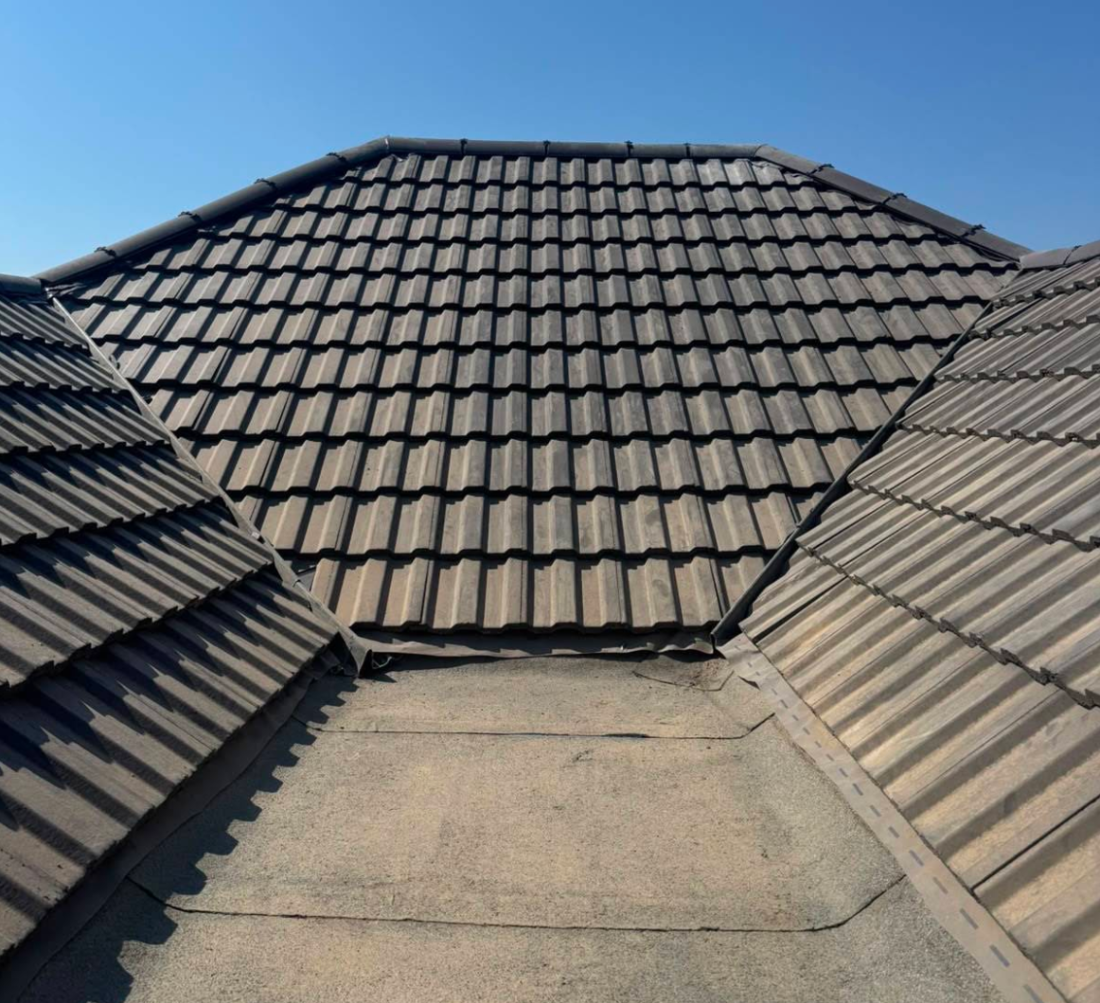
How a new roof is fitted properly
A new roof is more than new tiles on top. The work underneath is what keeps water out for decades, so this is the order it should happen in.
Survey and written quote
We look at the roof, the loft and the gutters, or go through photos you send on WhatsApp. You get a written quote that lists exactly what is included.
Scaffold and protection
A full scaffold goes up with edge protection, so nobody works from ladders alone. Plants, drives and windows are covered before anything comes off.
Strip and inspect
The old tiles, battens and underlay come off. With the roof open we check rafters, wall plates and ridge timbers. Anything rotten is shown to you and agreed before extra work is done.
Underlay and battens
A breathable membrane goes on, then new treated battens set out to the correct gauge for the tile or slate you've chosen.
Tiles or slates
The covering is fixed with the right nails and clips for your roof's exposure, with extra fixings at the edges, ridge and verges where the wind lifts hardest.
Detailing and clear-up
Ridge, hips, valleys, verges, lead flashings and vents are finished. Then the waste is cleared, the gutters checked and the finished roof talked through with you.
The rules a new roof has to meet
Rules are there to protect your home and the people working on it. Here is what usually applies.
Building Regulations
Re-roofing usually counts as building work. That can include insulation standards (Approved Document L) and fire spread near boundaries (Approved Document B). AV Builders & Roofing will tell you what applies to your roof before work starts.
BS 5534
This is the code of practice for slating and tiling. It covers battens, underlay, fixings and wind uplift, and it is the benchmark a properly fitted roof is judged against.
Working at height
The Work at Height Regulations 2005 are why a proper scaffold and edge protection should be on any re-roof.
Planning permission
A like-for-like replacement normally doesn't need it. Listed buildings, conservation areas, or a change of material or roof shape may, so check with the council first.
Asbestos
Older garages and outbuildings sometimes have cement sheet roofs that contain asbestos. Don't break them up. They need testing and specialist removal before any roofing starts.
Choosing the right covering for your home
The best material depends on your house, the pitch of the roof and how it looks from the street. We'll talk through the options and what each one means for weight, look and upkeep.
Concrete interlocking tiles
A wide choice of profiles and colours, and a sensible price. The usual choice for most family homes and extensions.
Best for: everyday homes and larger roofs
Clay plain tiles
A traditional small-format tile with a colour that lasts. Often chosen to match period homes or neighbouring roofs.
Best for: older and character properties
Natural slate
A thin, fine finish and a long life, but it needs skilled fixing and the structure must suit it.
Best for: period homes and a premium look
Composite slate
The slate look at a lower weight. Check the fire rating and manufacturer's fixing details for your site.
Best for: slate appearance without the weight
GRP fibreglass flat roofs
A one-piece covering laid on a firm deck, with trims and upstands formed to suit the roof. No joints in the main surface.
Best for: extensions, garages and dormers
EPDM rubber flat roofs
A single flexible rubber membrane with few joints, bonded to the deck and sealed at the edges.
Best for: larger flat areas and straightforward shapes
What a new roof quote should include
- Scaffolding and edge protection
- Stripping the old covering and taking the waste away
- Inspection of rafters, wall plates and timbers
- New breathable underlay
- New treated battens
- New tiles, slates or flat roof system
- Ridge, hips, verges and valleys
- Lead flashings round chimneys and abutments
- Roof ventilation where needed
- Fascias, soffits and guttering, if you want them done
- Clearing up and a walk-round at the end
- Any extra timber repairs, agreed with you before they're done
What affects the price of a new roof
No two roofs cost the same. These are the things that move the number.
- Size and pitch. More area and steeper slopes mean more materials and more time.
- The covering you choose. Slate and clay cost more than concrete tiles.
- Access and scaffolding. Terraces, narrow drives and tall or three-storey houses all change the scaffold.
- Roof shape. Hips, valleys, dormers and chimneys add detailing.
- Condition underneath. Rotten timbers need replacing before the new covering goes on.
- Extras. Insulation, fascias, soffits, guttering, vents and rooflights.
Looking after your new roof
A new roof needs very little, but a few habits make it last.
- Check after storms. Look from the ground, or use binoculars, for slipped tiles or lifted ridge.
- Keep gutters clear. Blocked gutters push water back under the edge of the roof.
- Go easy on cleaning. Avoid pressure washers and scraping tiles. Use a soft brush or a moss treatment.
- Cut back overhanging trees. They drop leaves, hold moisture and rub the surface.
- Keep your paperwork. Hold on to the quote and any photos of the work for insurers and future buyers.
- Spot something odd? Tell us early. Small fixes cost far less than the damage they prevent.
I trusted Deep and his team with my roof and they did an exceptional job. Deep talks to you throughout the process so you are always informed. He also physically shows you the work as it is being done so you know there aren't any corners cut.
Homeowner review, roof replacement
New roof questions, answered
How long does a new roof take?
On an average house it's usually a matter of days rather than weeks. Size, roof shape, the covering you've chosen and the weather all play a part, and a roof with several hips, valleys or dormers takes longer. Your written quote will give a realistic timescale.
Do I need planning permission for a new roof?
A like-for-like replacement normally doesn't need planning permission. If your home is listed, in a conservation area, or you want to change the material or the shape of the roof, check with your local council first. Building Regulations will usually apply either way, and AV Builders & Roofing will tell you what affects your roof before work starts.
Can a new roof go over the old one?
For a pitched tiled roof it's rarely a good idea. You can't inspect the timbers underneath, the extra weight may be too much for the structure, and the underlay and battens can't be fitted correctly. Stripping back to the rafters is the way to get a roof that lasts.
What happens if you find rotten timbers once the roof is off?
We show you, usually with photos, and explain what needs replacing and why. Any extra timber work is agreed with you before it's done, so there are no surprises on the final bill.
Do I need to move out while the roof is replaced?
No. You can stay at home, though there will be noise and some dust in the loft. Work is done in sections and the roof is made weathertight at the end of each day.
Should I replace the fascias and guttering at the same time?
Often, yes. The scaffold is already up, and old fascias and soffits are frequently rotten behind the guttering. Replacing them while the roof is open avoids putting up a second scaffold later. You can have them included as an option in your quote.
Where we fit new roofs
We take on new roofs across Birmingham and the surrounding areas. Here are the nearest districts.
Also covering Selly Oak, Sutton Coldfield, Solihull, Smethwick and West Bromwich. See every area we cover.
Get a written quote for your new roof
Tell us about the house and send a few photos of the roof. We'll come back with a clear written quote.